Monday, 9 April 2018

Welsh Government cracks down on zero-hour contracts in homecare

UNISON has welcomed the Welsh Government’s decision to curb the use of zero-hours contracts for thousands of homecare workers.

Care providers are now required to give homecare workers a choice of contract after a three-month period of employment.

New regulations also oblige those providers to ensure that time allocated for travel and care is ‘clearly and transparently set out’ – with the aim of tackling ‘call-clipping’ and preventing care time being cut short by travel time between visits.

The move follows Welsh Government research that found a “substantial number” of Wales’s 18,000 homecare workers – possibly as many as 80% – were on zero-hours contracts.

Social care minister Huw Irranca-Davies said that the new regulations “offer staff in the social care sector a fairer deal and help to safeguard the quality of care and support which people receive in their own homes.

“There is a very clear link between the use of zero-hours contracts and a reduced quality of care, due to issues around the continuity of care and communication between workers and those they support.

“These measures will ensure workers are offered a choice of contractual arrangements, Mr Irranca-Davies added. “Requiring providers to distinguish clearly between travel time and care time when arranging services will also improve the experience of people needing care.”

The Welsh Government has also opened Social Care Wales’s workforce register to include homecare workers, as part of its ongoing commitment to professionalise the workforce.

Responding to the announcement, a UNISON Cymru/Wales spokesperson said: “Zero-hours contracts are exploitative, so it is great news that the Welsh Labour government has acted in this way.

“UNISON Cymru/Wales has been continuously lobbying ministers here on the issue. Their action is a good example of partnership working, where the input of the care workforce and trade unions is valued.

“This measure is one step forward in dealing with the complex issue of precarious employment,” the spokesperson added. “We continue to campaign for social care services to remain under the direct and democratic control of local authorities and under national pay bargaining.”

The region recently launched the union’s Residential Care Charter and re-launched its Ethical Care Charter at the Welsh Assembly. And it’s actively involved in discussions with Social Care Wales about the professionalisation of care.

Earlier this month, general secretary Dave Prentis attended a signing ceremony as Blaenau Gwent became the first local authority in Wales to adopt the Ethical Care Charter.

“Hopefully others will follow,” the Cymru/Wales spokesperson said. “We are determined to do our level best for care workers across Wales.”

The article Welsh Government cracks down on zero-hour contracts in homecare first appeared on the UNISON National site.


from RSSMix.com Mix ID 8239598 https://www.unison.org.uk/news/2018/04/welsh-government-cracks-zero-hour-contracts-homecare/
via IFTTT

source https://childrensplayareadesigns.tumblr.com/post/172761052697

Friday, 6 April 2018

One last attempt to save NHS bursaries, says UNISON

Commenting on plans that would see a parliamentary debate after Easter recess on government plans to scrap postgraduate student nursing bursaries, UNISON head of health Sara Gorton said:

“The government needs to admit it got this one very wrong.

“Official figures show that government penny-pinching is deterring a whole generation of nurses and other health professionals from their chosen career in the NHS.

“The toxic combination of underfunded services, wage stagnation and increased pressure on services has created a whole new uncertainly into which graduates are understandably not willing to enter into knowing they will leave with such huge debts.

“This is the government’s last chance saloon. It’s ministers’ final opportunity to reverse a huge own goal and a ridiculously damaging decision.”

The article One last attempt to save NHS bursaries, says UNISON first appeared on the UNISON National site.


from RSSMix.com Mix ID 8239598 https://www.unison.org.uk/news/press-release/2018/04/one-last-attempt-save-nhs-bursaries-says-unison/
via IFTTT

source https://childrensplayareadesigns.tumblr.com/post/172662913347

Thursday, 5 April 2018

New study shows 1,000 Sure Start children’s centres may have shut

A new study shows that as many as 1,000 Sure Start children’s centres may have been closed since 2010, double the government’s official estimate.

The Sutton Trust found that confusion over identifying individual centres and how changes were reported meant the figure of 500 closures was a vast underestimate.

They also found that many centres have remained open in name only. They have been hollowed out, only offering a fraction of the services they used to.

Sure Start centres were established under the Labour government in 1998. Their aim was to give young children the best start in life by offering co-ordinated high-quality support in early education, health and family support, all in one location.

UNISON is the biggest union for early years workers, with many thousands working in Sure Start centres.

The union’s assistant general secretary, Christina McAnea, commented: “This report reflects what our members have told us about the devastating cuts in children’s centres.

“Sure Start centres are about helping children, especially those from disadvantaged backgrounds. They have been proven to have a positive impact on children and families, so it is absolutely shocking that so many have been shut down, and that the real figures have been hidden from the public.

“The government promised a review of children’s centres in 2015. That has still to be published and all inspections of centres have been put on hold.

“Children’s centres have been left in limbo,” Ms McAnea added. “It is difficult to have any faith that this government has proper long-term plans for their future. We need to reverse the massive cuts to local authority funding for these services that are so vital for young children and their families.”

The article New study shows 1,000 Sure Start children’s centres may have shut first appeared on the UNISON National site.


from RSSMix.com Mix ID 8239598 https://www.unison.org.uk/news/article/2018/04/new-study-shows-1000-sure-start-childrens-centres-may-shut/
via IFTTT

source https://childrensplayareadesigns.tumblr.com/post/172624586302

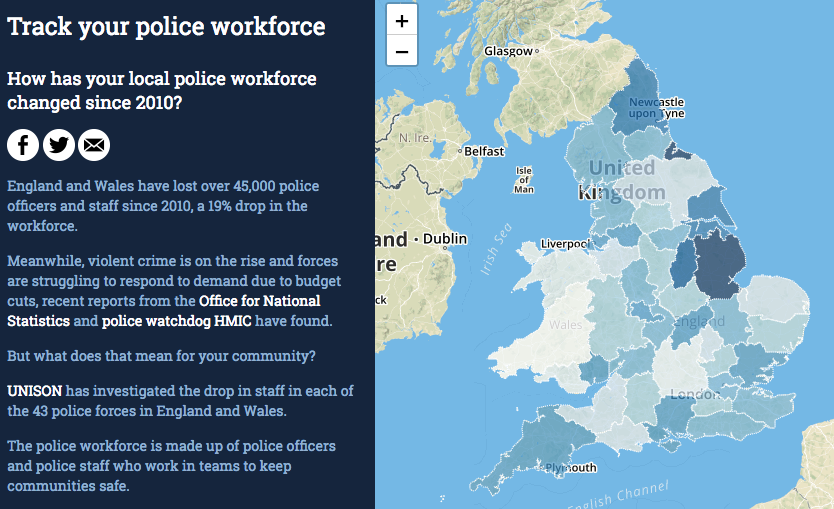
Violent crime is on the rise, but who is working to keep you safe?

You may have seen in the news that violent crime is increasing. To tackle it we need strong police forces, but is that what we have?

UNISON has investigated the changing workforce in the 43 police forces in England and Wales. We’ve looked at police officers, but also police staff, because everyone working for the police plays a vital role in keeping communities safe, from the officers to PCSOs, administration staff, and many more specialist roles.

So what does the force look like in your area? Click on the map below then hover over your area to see the numbers.

UNISON is the biggest union for police staff, with 34,000 members who work in the police.


Map of England and Wale

The article Violent crime is on the rise, but who is working to keep you safe? first appeared on the UNISON National site.


from RSSMix.com Mix ID 8239598 https://www.unison.org.uk/news/article/2018/04/violent-crime-rise-working-keep-safe/
via IFTTT

source https://childrensplayareadesigns.tumblr.com/post/172621900517

Blog: Every signing really matters

It was a huge pleasure to be in Ebbw Vale yesterday to celebrate Blaenau Gwent Council signing our Ethical Care Charter – the first Welsh council to sign.

Every council which signs the charter means more UNISON members gaining guarantees about their rights and their pay – and better care for the most vulnerable in those communities. That means every signing really matters.

Now that Blaenau Gwent have become the first Welsh signatory to the charter, we hope this incentivises other councils to follow suit. Thank you to Ian, Dave and Isabel from the branch for all of their work in securing the council’s support for the charter, and to the council for their support for local care workers.

The Ethical Care Charter is something I’m really proud of, and is a concrete example of how our union can deliver real change for our members – I hope we’ll see many more councils signing up in the years ahead.

The article Blog: Every signing really matters first appeared on the UNISON National site.


from RSSMix.com Mix ID 8239598 https://www.unison.org.uk/news/2018/04/blog-every-signing-really-matters/
via IFTTT

source https://childrensplayareadesigns.tumblr.com/post/172621900437

Wednesday, 4 April 2018

Challenging South Korea’s war on workers

Cho Sung-deok has spent a year in prison because of his trade union activity.

Mr Cho is a former airport security guard and vice president of the Korean Public & Social Services and Transport Workers’ Union (KPTU).

In his role as a guard at Incheon International airport, he was working in the public sector but was subcontracted to a private company. He and his colleagues faced low wages and poor working conditions. Sung-deok began to organise to fight back, but after going on strike, he was sacked.

Deciding to do more to protect workers’ rights, he ran for and was elected to the position of KPTU vice president.

In 2015, the South Korean government was making plans for further privatisation of public services as well as changes to employment laws, enabling poorer working conditions and protections.

Unions organised a protest on 1 May 2015. The police tried to suppress the demonstrations, using what many described as ‘disproportionate force.’ Sung-deok was involved in some of the clashes between the protesters and police. Twenty days later, he was summoned for questioning by the police.

Political prisoner

Sung-deok learned that the police had cameras following the trade union leaders at the protest. Later, a warrant to search his mobile phone was issued on behalf of four different authorities – the South Korean national intelligence service, the police, the prosecutor and the intelligence department of the army.

After questioning, the police had to decide whether they had enough evidence to hold him and then a judge had to decide if the warrant was fair or not. “For that 24 hours I was anxious and uncomfortable and actually, after it was decided and the decision was over, I felt a little bit more relaxed.”

Sung-deok was imprisoned for a number of violations of the country’s Assembly and Demonstration Act, including obstruction of public duty and an assault on a police officer.

Life as a political prisoner in South Korea is difficult. Sung-deok’s  cell was smaller than others and there was no running water. Winters in South Korea get extremely cold, and the heating in his cell was on for only two hours per day. Small differences made his conditions worse than other prisoners. “They would dim the lights in other cells, but the light was on all night in my cell,” he explains.

It was a hard time, but Sung-deok was more worried about other people. “The thing I was uncomfortable about was that the workplaces I’m in charge of, the precarious workers, a lot of them had disputes going on, so what was going to happen to them if I’m gone?”

He was also worried about his father, so he didn’t tell his parents that he was in prison. “My father had just had cancer surgery, so he was in a very difficult situation. I thought it would maybe have a bad effect on his health.”

The Republic of South Korea

Population: 50,982,212

Average life expectancy: 82 years

Have they signed the ILO (International Labour Organization) conventions? Partially. They haven’t signed the conventions on discrimination and child labour.

Number on the Human Development Index: 18 (1 is the best. The UK is number 16)

Sung-deok expected to have to make sacrifices for being a trade unionist because, he explains, the movement in South Korea grew out of the fight against dictatorship in the 1980s.

After a year, he was released, and in early March 2017 it looked as though things would improve for trade unionists.

President Park Geun-hye became embroiled in a corruption scandal. The whole country began protesting against the government and she was impeached. Moon Jae-in, a former student activist and a human rights lawyer who promised better working conditions, was elected as her successor.

President Moon represented hope for trade unionists. But so far, he has not lived up to his promise.

While Sung-deok was released, several of his colleagues remain behind bars under President Moon, including Han Sang-gyun, the president of the Korean Confederation of Trade Unions (KCTU) and KCTU general secretary Lee Young-joo.

Even though he has been in prison – and some of his colleagues are still behind bars – Sung-deok is determined to continue his work supporting working people.

He says that a few years before he was imprisoned, he faced surgery and spent time reflecting on what brought him the most happiness. “I asked myself, ‘What in my life have I gotten the most from? What have I felt the most fulfilled by?’ It was the union work. So why would I give up something that fulfils me?

“I think around the world we’re doing trade union work because we feel it is helping people – that’s why we do it. It’s helping humanity.”

The article Challenging South Korea’s war on workers first appeared on the UNISON National site.


from RSSMix.com Mix ID 8239598 https://www.unison.org.uk/news/magazine/2018/04/challenging-south-koreas-war-workers/
via IFTTT

source https://childrensplayareadesigns.tumblr.com/post/172593922667

Tuesday, 3 April 2018

Hull recycling workers strike for sick pay

Recycling workers working for FCC Environment in Hull have started two weeks of strike action for decent pay sick pay, and are asking for donations to their hardship fund.

The 14-day strike, which started on 29 March, is the second round of action, following a week-long strike at the beginning of the month.

The UNISON members are mounting a picket from 6am every day at the FCC Wilmington waste transfer station in Hull.

Their employer is a wholly-owned subsidiary of a Spanish company that describes itself as “a worldwide leader in citizen services, specialised in environment, water and infrastructure”. It reported a 12.7% increase in earnings in the first quarter of 2017, totalling $188m globally.

But UNISON Hull City branch secretary Adrian Kennett says that, “despite the company’s significant profits, it refuses to to pay the workers who make them the profits decent pay and conditions.”

The branch has been campaigning for a better sick scheme for a long time. Last year, a member was diagnosed with cancer, but was denied sick pay.

“We asked for this to be included in pay talks,” says Mr Kennett, but the company refused.

At the same time, that company has not increased a pay offer of 2.5% increase, which most of our members were going to get anyway as part of the increase in the national minimum wage, which came into effect on 1 April.

“This has left our members with no choice but to take industrial action,” says UNISON.

The branch, supported by Yorkshire and Humberside region, is asking fellow UNISON branches to give generously to support the strikers, with cheques made payable to UNISON Hull City and sent to:

UNISON Hull City branch
Town Hall Changers
39 Alfred Gelder Street
Hull
HU1 2AG

Find out more about the issue at hullcity-unison.org.uk

Contact the branch by email at info@unisonhull.org.uk or by phone at 01482 318670

The article Hull recycling workers strike for sick pay first appeared on the UNISON National site.


from RSSMix.com Mix ID 8239598 https://www.unison.org.uk/news/article/2018/04/hull-appeal/
via IFTTT

source https://childrensplayareadesigns.tumblr.com/post/172556206557

Children's Play Area Designs

Colourful playground markings have become really popular in numerous schools and nurseries as they create an attractive design with enjoyab...